Ground-cover installation
Crawl Space Vapor Barrier Installation in Hickory, NC
Choose material grade, floor coverage, seam treatment, pier fit, and edge attachment based on how the crawl space is used and where soil remains exposed.
Disclosure: Hickory Crawl Space Help is an independent service that helps connect homeowners with local crawl space professionals. We do not perform contractor services ourselves. Your request may be shared with a local provider who can assist with your project.
Homeowner request path
Hickory, NC- Share the crawl-space issue you are seeing.
- Choose vapor barrier, moisture, encapsulation, waterproofing, or floor-support help.
- Your request may be connected with a local provider when available.
Quick answer: A basic vapor barrier covers exposed soil so ground moisture has a harder path into crawl-space air. The installation succeeds through continuous coverage, durable material, joined seams, and careful fitting around every pier and penetration. Request a liner scope with the approximate floor area and current damage.
Choose the scope that matches the moisture source:
- Basic vapor barrier: stay with this ground-cover scope when the job is covering exposed soil and detailing seams, piers, and penetrations.
- Full encapsulation: compare a sealed floor, walls, vents, and access with managed conditioning when ground cover alone is not the intended enclosure.
- Waterproofing: address active leaks, standing water, or other bulk-water entry first. A liner alone does not solve active water.
- Broader moisture control: review humidity, air leaks, drainage, and the drying system together when the source or needed combination is not yet clear.
Once the right lane is clear, request a scope review.
Choose the liner for traffic and puncture risk
Basic 6-mil polyethylene can serve as ground cover in a crawl space with light service traffic and a smooth prepared floor. Reinforced liner adds tear and puncture resistance where stones, debris, storage, low clearance, or repeated heating, plumbing, and electrical access put more stress on the sheet. Ask for a named material and thickness instead of accepting “heavy plastic” as a specification.
Prepare the floor before covering it
Remove sharp debris, loose scraps, and material that would hold the liner off the soil. Identify standing-water routes before covering them. Smooth high points where practical, preserve access to drains and equipment, and decide whether the old liner can remain without trapping mud, contaminated debris, or water beneath the new layer.
Join seams and fit obstructions
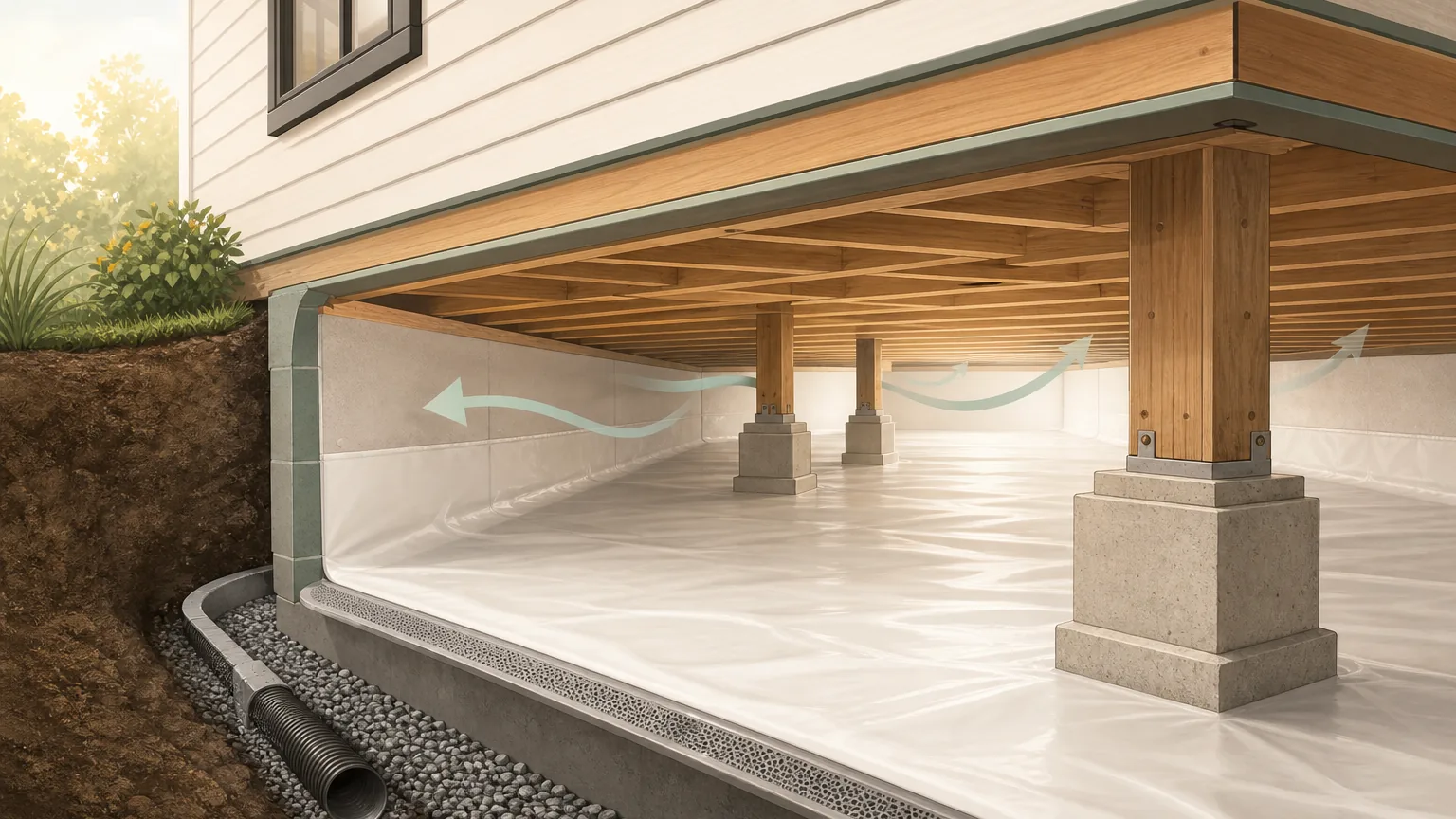
Adjacent sheets should overlap enough to stay joined during service and receive compatible tape when the scope calls for sealed seams. Cuts around masonry piers, posts, pipes, drains, and wiring need shaped pieces and closed joints rather than wide slits that expose soil. Boots or collars can reinforce busy penetrations. The finished path from the access door to equipment should resist bunching and tearing.
Define the wall edge
A loose-laid ground cover may turn up at the perimeter without becoming an air-sealed wall liner. A larger vapor-barrier scope may extend partway up masonry and use termination bars or other mechanical fastening. The estimate should name wall height, attachment method, pier treatment, and any visible inspection space left for termite review. A bare soil strip should never appear by accident; it should reflect an explained inspection or construction detail.
Repair, supplement, or replace the old liner
- Repair: isolated punctures or open seams in material that remains clean, flexible, and sound.
- Supplement: uncovered sections where new material can overlap and join to a stable existing sheet.
- Replace: widespread thin, brittle, torn, muddy, floating, contaminated, or poorly fitted liner that cannot support reliable seams.
How this differs from full encapsulation
A ground-cover barrier can leave foundation walls, vents, and the access door open. Encapsulation creates a sealed floor-and-wall enclosure and adds managed conditioning. Use the comparison page when symptoms extend beyond ground vapor.
Vapor-barrier cost and estimate details
Use $1,000 to $4,000 as a planning range for basic ground-cover installation. Ask the estimate to separate floor preparation, old-liner removal, material grade, seam tape, wall and pier work, difficult access, debris disposal, and drainage exclusions. The Hickory cost guide lists the ranges for work beyond this ground-cover lane.
Water can defeat a new liner
A floating or muddy sheet points to a liquid-water problem. The waterproofing page covers drains, sump equipment, and discharge; the liner belongs after that route is understood.
Disclosure: Hickory Crawl Space Help is an independent service that helps connect homeowners with local crawl space professionals. We do not perform contractor services ourselves. Your request may be shared with a local provider who can assist with your project.
Vapor barrier request
Describe the floor-covering scope
Include approximate dimensions, access height, current thickness if known, exposed-soil areas, seam failures, pier count, old-liner condition, and whether water sits above or below the sheet.
- Identify high-traffic paths and sharp debris.
- Show where edges and penetrations open.
- State whether you want loose-laid or attached edges priced.
Vapor-barrier material and installation questions
What does a basic crawl-space vapor barrier cover?
A basic barrier covers exposed soil with polyethylene, overlaps and tapes seams, and fits the material around piers and penetrations. The scope should state whether edges remain loose, rise partway up walls, or receive mechanical attachment.
Is 6-mil plastic enough for a crawl space?
A 6-mil sheet can serve as basic ground cover where traffic and puncture risk are low. Reinforced liner better resists stones, debris, storage, and repeated service access. Thickness alone does not correct loose seams, exposed soil, or standing water.
Should an old liner be patched, supplemented, or replaced?
Patch isolated damage when surrounding material remains sound and clean. Supplementing may work where coverage is incomplete and the existing sheet can be joined reliably. Replace liner that is broadly torn, brittle, muddy, floating, contaminated, or too damaged to hold sealed seams.
How much does basic vapor-barrier installation cost?
Use $1,000 to $4,000 as a national planning range for basic ground-cover vapor-barrier work. Crawl-space area, access, old-liner removal, debris, pier count, material grade, seam treatment, and wall attachment affect the quote.